The yellow residence permit kit: how to fill it in without mistakes
Each person is given one kit only, so it is not something you fill in standing at the counter. What is inside, the three boxes that send back the most applications, what to photocopy, what never to put in, and the two sheets you must be holding before you leave.
13 min read
In this article
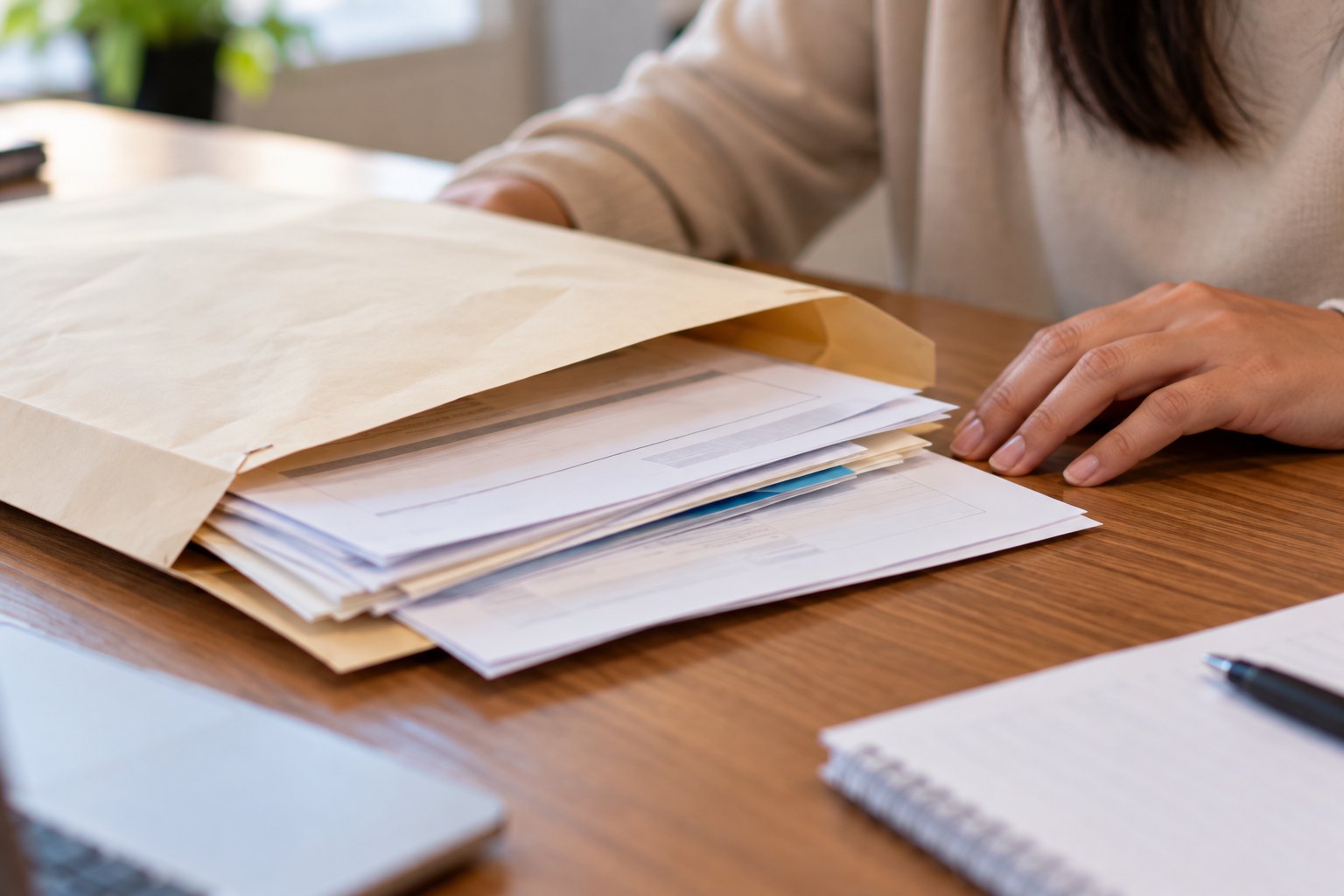
Everyone knows the yellow envelope and almost nobody explains it. Inside there are two dense forms, written in an administrative Italian that is nobody's mother tongue, and an instruction sheet that assumes you already know what you are doing.
This guide walks you from picking up the kit to walking out of the post office with the receipt in your hand. What it costs and what the receipt is worth are explained in the renewal guide linked below: this article is only about filling it in.
One thing has to be said first, because it is not a wrong box but a closed door: there are two deadlines. If you have just arrived and you are applying for the first time, the application goes in within eight working days of your entry into Italy. If you are renewing, at least sixty days before the permit expires.
Picking up the kit
The kit is free and you collect it at a post office. Each person is given one kit only, and to get it you must show an identity document or the residence permit you hold. Associations and patronati that work on immigration also have them.
One per person has a practical consequence: if you ruin it, you will not be handed another one on the spot. So do not fill it in standing at the counter. Take it home, read it, and write calmly.
What is inside
- Form 1, the main one: who you are, which permit you are asking for, where you live, your passport details, your family members.
- Form 2, which does not concern everyone.
- The filling-in instructions. Do not throw them away: they are the only thing that tells you, for your case, which boxes to skip.
- The pre-printed payment slip.
- The envelope.
The paper kit is not the only route
There is a second route that the Ministry of the Interior's portal puts on the same footing, and almost nobody mentions it: a patronato or an authorised Comune fills the application in for you through a dedicated portal, and hands you the printed copy together with the envelope. You then take it to the post office as if you had written it by hand.
The portal uses one word for this service: free. And it is not the same thing as being helped to fill in the paper kit — it is a different procedure, with no single sheet you can ruin.
Three rules before you write
- Block capitals, black pen. The forms are read by a machine before they are read by a person: a letter outside its box or a pale colour becomes unreadable data.
- No crossings-out, no correction fluid. A box corrected twice is a box someone will have to interpret, and whoever interprets can get it wrong on your behalf.
- No originals and no photographs inside the envelope. The police documents say so in capitals. The kit takes photocopies only. Originals and passport photos are brought to the appointment.
Form 1, where people go wrong
Most of form 1 is your own data, copied from your passport letter by letter: your name and surname must be identical to the document, even if people in Italy call you something else or the order of the names looks wrong to you. The form is not the place to fix a name that was recorded badly: that is a different procedure.
If you hold two passports, an old one and a new one, look carefully at which one you are copying: at the counter you are identified with the one you used to fill in the kit, and it has to be valid.
Three points are where mistakes actually happen.
The type of request and the reason
At the top you have to state what you are asking for — renewal, first issue, duplicate, update, conversion — and on what grounds. It looks obvious, and it is the box that sends back the most applications.
If you are renewing, the reason must be the same one written on the permit you are holding. If your permit says «lavoro subordinato» (employed work), the form says employed work — even if you have changed employer since. Changing the reason is not a renewal, it is a conversion, and that is a different request. If you are not sure which one you need, ask before filling in the form, not after.
And there is a door that closes on its own: an update or a conversion can only be requested on a permit that is still valid. Once it has expired there is nothing left to convert, and the route becomes another one.
Your address
The address you write is where the police headquarters will write to you: the appointment letter, any new appointment, a request for a missing document. It must be the address where post actually reaches you and where your name is on the doorbell or the letterbox.
Write your phone number and email carefully too: new appointments now often travel by text message. And if you move house while the file is open, moving is not enough: updating the permit for a change of address is a request you have to make, again with the kit.
Children
If you have minor children registered on your permit, they must be listed on the form and they must come with you on the day of the appointment. This is the most common thing people forget, and it costs a second appointment.
Who signs, and how many kits are needed, depends on the child's age, and the two rules are not alike:
- Under fourteen, the child is included in the parent's application: one kit only, handed in and signed by the parent, who is the person identified at the counter. The payment slips, though, are more than one: one of €30.46 for each child, plus the parent's own.
- From fourteen to eighteen, the kit is in the young person's name and it is they who hand it in, accompanied by a parent: both of them sign. If they turn up alone, the post office will not accept it and you have to go to the police headquarters.
Form 2: does it apply to you?
Not everyone fills in form 2: it is the work and income part. Inside it are the type of employment and contract, the employer's details, the residence contract signed at the Sportello Unico, self-employment, how much you earned and which document proves it, and registration with the employment centre.
It is filled in only after every other part of form 1 is finished. Which sections apply to your case is stated in the instructions inside the kit, the only sheet written about your own situation. If it does not apply to you, form 2 is left blank and put in the envelope anyway.
Who does not go through the post office
The envelope is handed in by the applicant and nobody else. Three cases go to the police headquarters instead:
- anyone unable to travel to the post office;
- anyone acting as support administrator, legal guardian or court-appointed representative: always, even for an application that would normally go through the post office;
- a young person over fourteen who arrives without a parent.
And not every request goes through the post office in any case. The immigration portal publishes two tables: one with the applications that are filed at a post office, the other with those filed at the immigration office of the police headquarters. If you are not sure which one yours is, that is what you check before collecting the kit.
The photocopies that go inside
Which documents you need depends on the grounds of your permit, and the exact list is published by your province's police headquarters: that is the list to follow, not a generic one found online. Photocopies must be A4. What applies to everyone:
- A photocopy of your passport — the immigration portal asks for the pages with your personal data and the pages with the entry visas. Many police headquarters want every page that has writing on it: when in doubt copy them all, because one page too many has never stopped an application.
- Your residence permit, expiring or expired, front and back.
- The €16 revenue stamp, bought at a tobacconist and stuck on the form.
- The documents for your grounds: contract and payslips for work, family documents for family reasons, enrolment for study, and so on.
- The receipt for the payment slip. Careful: there are two receipts. One goes inside the envelope, you keep the other — it is shown at the appointment at the police headquarters.
One piece of advice that costs nothing: photograph everything in the envelope before you hand it in, completed forms included. If in six months someone asks what you declared, you have the answer.
The payment slip
The slip is already inside the kit, made out to the Ministry of Economy and Finance on postal account 67422402. You write the amount: the cost of the electronic permit plus the fee, which depends on the length of the permit you are applying for. The exact figures are in the renewal guide linked here.
If you need more than one — which happens when you include children — further slips are available at the authorised post offices, the ones that receive applications.
If you are unsure about the amount, ask at the counter before paying. A wrong slip can be redone, but the file stops in the meantime.
At the counter
The envelope is handed in at a post office in the Sportello Amico network: not every post office receives applications, and the list is on the immigration portal. Do not seal it at home: it is handed in open, the clerk checks that everything is there, and on handing it in you pay the €30 service charge.
One thing to do before you leave the house: the application must already be signed. The immigration portal is blunt — an unsigned application is not even examined. The signature goes on last, once everything else is written.
Before you leave the post office, check that you are holding two sheets:
- the insured-mail receipt, with the insured-mail code and the hologram code;
- the appointment letter for the police headquarters, with date, time and address.
The second sheet may not be there, and that is not a problem: if the police headquarters' diary is full at that moment, the appointment arrives later by registered letter, as soon as a slot opens up.
The receipt is your document until you collect the new permit. Photograph it straight away and keep the photo where you can find it. The two codes are also the keys to the immigration portal's private area, where you can see how far along your file is.
The day of the appointment
You go to the appointment in person, with any minor children registered on the permit. Bring:
- your original passport and the originals of every document you attached as a photocopy;
- your residence permit, expired or still valid;
- the insured-mail receipt with the appointment letter, and the second payment-slip receipt, the one that did not go into the envelope;
- four passport photographs on a white background, at least 45 mm high and 35 mm wide: one of them ends up on the permit itself. And four for each child under fourteen who comes with you.
At the police headquarters your fingerprints are taken. It is a normal step of the procedure, not a police check on you.
If you cannot go
Missing the appointment is possible, but only with a real, documentable reason: illness, a hospital stay, a sudden obstacle. The reason has to be proved with a document — for health, a medical certificate.
Tell them before the day of the appointment if you can. Telling them afterwards still works, but beforehand counts for more: it says you did not simply forget.
There are two ways to get the certificate to them, in this order:
- In person, taking the document to the immigration office of the police headquarters. This is the safest, because you hand it to someone.
- By PEC (certified email), attaching all the documentation. It matters because it leaves a trace: an ordinary email can be said never to have arrived, a PEC cannot. The address is the one of your province's immigration office, written on its page. In the subject line put your surname, first name, date of birth and the insured-mail number.
The police headquarters then set a new appointment and send it by registered letter, text message or PEC, to the contact details you wrote on the form. From here the hard part is yours: those details must be right and you have to watch them. A number you no longer use or an inbox you never open are worth as much as no details at all.
On a second absence without a justified reason the file is closed. This is not a rule written in a national law: it is what the police headquarters state on their own pages. Closed means starting again from scratch, new kit and new costs included.
How you give notice, and how far in advance, is decided by each police headquarters on its own: it is written on the page of your province's headquarters. That is where you look before writing.
The mistakes that cost a second round
- Putting originals or passport photos inside the kit.
- Turning up at the police headquarters with two photographs instead of four.
- Getting the grounds of the permit wrong, or asking for a renewal when a conversion was needed.
- Handing in the application unsigned: it will not be examined.
- An address where post does not arrive.
- The revenue stamp forgotten or not stuck on.
- Partial photocopies of the passport.
- Missing the appointment without telling anyone and without a certificate to explain why.
- Filing too late: eight working days from your entry into Italy for a first application, sixty days before expiry for a renewal.
With Bahay Italia
The part of this the app can take off your hands is the remembering: the permit expiry date with a sixty-day reminder, the list of documents to prepare for your grounds of stay, and the administrative terms explained in your language while you fill things in. We do not ask you to upload the permit: we only keep the dates.
This guide explains the national procedure. The list of documents to attach changes with the type of permit and is published by your province's police headquarters: that is the authoritative list. If there is something particular about your situation, a patronato or an authorised Comune will fill the application in with you, free of charge — and for a complicated case, or after a refusal, the person to talk to is a lawyer.