
Registry certificates download from home: which ones, and when the 16-euro stamp duty applies
Sixteen registry certificates plus civil status ones, free, for you and for the people you live with. The 16-euro stamp duty applies only to certain uses, and one question can save you it altogether.
Redazione Bahay 9 min read

In this article
- Which certificates you can download, free: four families of them
- The 16-euro stamp duty: when it applies and when it does not
- The question that can save you both the certificate and the stamp
- You do not even have to write the self-declaration: the site prepares it
- How long it lasts: three months, not six
- If you have no SPID, CIE or CNS
- The next step
Someone has asked you for a certificato di residenza (certificate of residence) or a stato di famiglia (household composition certificate), and you are wondering when you will find time to go to the town hall. In most cases you do not need to go: those papers can be downloaded from home, in a few minutes, free of charge.
It is done in the citizen area of ANPR (the National Register of the Resident Population), which you enter with your electronic identity card or with SPID: how to log in and how to check your own record is explained in ANPR: check how you are recorded.
Which certificates you can download, free: four families of them
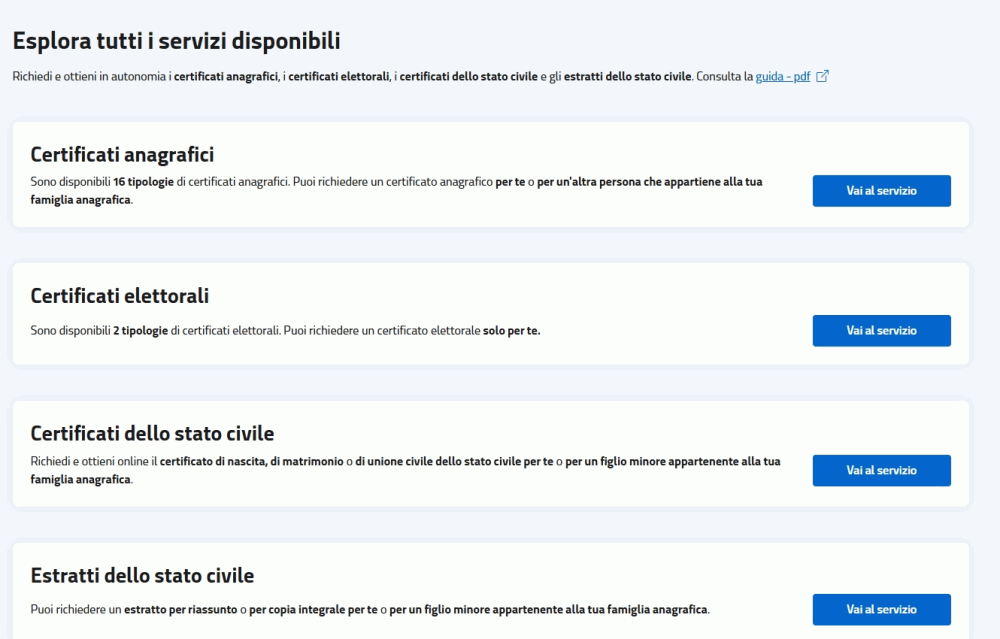
Since 15 November 2021 certificates can be downloaded online at no cost and with no counter fees. Inside the citizen area, under Servizi, they are grouped like this:
- Registry certificates: sixteen types, which you can request for yourself or for another member of your household. These are they:
- of birth, of marriage, of civil union;
- of citizenship, of existence in life, of free status, of civil status;
- of residence, of residence effective from 1 January 2022, of AIRE residence (the register of Italians living abroad), of residence in a cohabiting community;
- of household composition, of household composition and civil status, of household composition with family relationships, of AIRE household composition;
- of cohabitation contract.
- Electoral certificates: two types, and these only for yourself.
- Civil status certificates: birth, marriage, civil union, for yourself or for a minor child in your household.
- Civil status extracts: in summary form or as a full copy, for yourself or for a minor child.
Two names that cause confusion. The stato di famiglia con rapporti di parentela also states who is who — wife, husband, child — and it is the one family paperwork almost always asks for: if that is what you need, the plain household certificate will not do. The certificate of residence effective from 1 January 2022 arrived on 23 April 2026 and is the only one telling a story rather than showing a snapshot: it certifies every residence in Italy recorded in ANPR since 1 January 2022, while the ordinary one states only where you live now. You can get it only if you have been resident in Italy without interruption since 2022, with or without stamp duty like the others, and for earlier years it is not issued online even when the residence is recorded in ANPR — for those you need the historical certificate, at the municipal counter.
If you are gathering papers for citizenship or for the EU long-term residence permit, keep the limit in mind: that certificate starts in 2022, so it covers the recent years and not the whole period you have to prove.
The difference between a certificate and an extract matters when a consulate asks, or for paperwork abroad: the full-copy extract reproduces the whole record with its annotations, while the certificate summarises it. If they ask for the extract, the certificate will not do.
The waiting differs too: a civil status certificate downloads at once, an extract does not. The extract is a request your municipality has to process: you send it, follow its progress under «Le tue richieste» and download it when it is ready. If you need it for a deadline, do not leave it to the last day.
⚠️ Only civil status records born digital are online
This is the part that sends people home empty-handed, so read it before trying.
The civil status service started on 31 March 2026 and covers only records created digitally by municipalities, that is, registered after the municipality joined the national digital archive of civil status registers. On 1 April 2026 the Ministry of the Interior counted more than 700,000 digital records: few compared with all those that exist, because they are the recent ones.
In your situation: if you married in Italy recently, the record is probably there. If your child was born ten years ago, or your birth record was transcribed in Italy some time ago, you almost certainly will not find it online — and that is not a fault of the website. That one is requested at the municipality holding the register, at the counter.
Registry certificates, on the other hand — residence, household composition and the other fourteen — do not have this limit: they come from the population registry and exist for everybody.
What is not available online
Historical certificates — the ones stating how things stood at a past date, for example where you lived in 2015 — and the death certificate cannot be downloaded from ANPR. Those are requested at the counter of your municipality of residence.
On the other hand registry certificates can also be requested in combined form: several pieces of data gathered into a single certificate instead of three separate sheets. The portal suggests the possible combinations as you choose.
It is issued at once, and it can be emailed to you
Issuing is immediate. Before downloading you see a preview: look at it, that is the moment when you notice a wrong detail. Then you download the PDF, and if you have saved your email address or digital domicile under «I tuoi dati» you can have it sent there. If you live in a bilingual municipality you can choose the second language of issue.
What comes out is a non-editable PDF with the Ministry of the Interior logo, a QR code and the Ministry's electronic seal — invisible to the naked eye, but there. It has the same legal validity as one collected at the municipal counter: it is not a copy that someone has to stamp.
The 16-euro stamp duty: when it applies and when it does not
The online certificate is free, but the imposta di bollo (stamp duty) is a separate thing: it is a state tax, it costs 16 euros and the municipality does not collect it. On registry certificates it is due as a general rule, except for the uses that the law exempts — the list is in Table B of presidential decree 642 of 26 October 1972.
When you request the certificate the site asks you to choose the use. Exempt uses include, for example, adoption, fostering and guardianship of minors, separation or divorce proceedings, a foreign pension, paperwork of non-profit organisations and amateur sports clubs, and documents to be filed in court proceedings.
If your use is not among them, since 2 August 2023 the stamp duty can be paid online through pagoPA, with no tobacconist and no second trip to the town hall: the ANPR citizen area is connected to the public payment platform.
Two warnings that matter more than they look:
- The use you declare stays printed on the certificate. Using a certificate obtained without stamp duty for something else exposes you to a penalty: it is not a formality.
- If you pick the wrong use, the document cannot be fixed. You request another one — if it was free you lost nothing, if it carried stamp duty you lost 16 euros.
The question that can save you both the certificate and the stamp
Before downloading anything, ask yourself who is asking you for that paper.
If it is a public office or a public service operator — the municipality, INPS (the national social security institute), the ASL (local health authority), a school, the questura, the electricity or gas company — it cannot demand the certificate: it must accept a declaration signed by you, or obtain the data itself. Certificates are valid only between private parties (article 40 of presidential decree 445 of 28 December 2000, as amended by law 183 of 2011).
This is not our reading of the law: the certificates page of the National Registry portal says it — in dealings with public administration and with public service operators the registry certificate is always replaced by the self-declaration.
So: a bank, an insurer, a lawyer, a landlord, a consulate — there the certificate is genuinely needed. A public office — your signature is enough, and you pay nothing.
You do not even have to write the self-declaration: the site prepares it
Still in the citizen area, among the services, there is Ottieni un'autocertificazione (get a self-declaration). It works in three steps: you choose which data to show — birth, household, civil status, residence, citizenship, existence in life — you give your identity document details, you read the summary and you download the sheet already filled in with the data taken from your record.
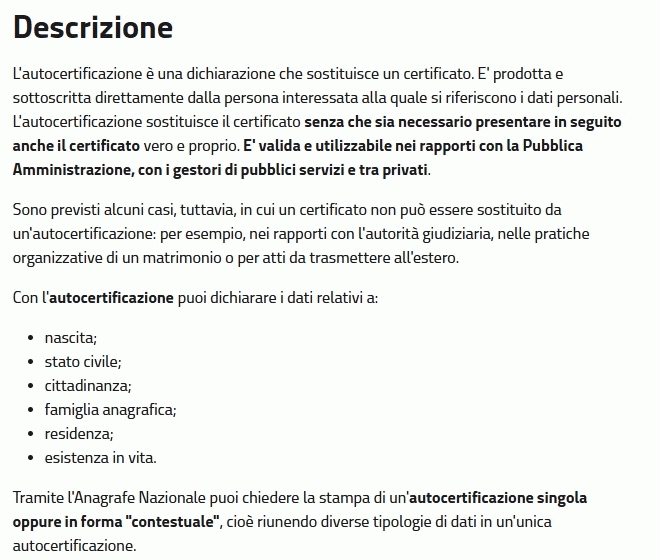
All the boxes come ticked: if you leave the selection as it is, the self-declaration will contain everything. Untick what has nothing to do with the matter at hand — an office asking only for your residence does not need your civil status, and one fewer piece of data circulating is one fewer piece someone keeps.
No stamp duty, no waiting, no queue: it is the shortest route whenever a public office is on the other side.
How long it lasts: three months, not six
A registry certificate is valid for three months from the date of issue, as the portal itself states. People often get this wrong, because public certifications in general are spoken of as lasting six months: registry ones last three.
There is no reason to keep an old one in a drawer: when you need it, another takes two minutes.
If you have no SPID, CIE or CNS
Two routes are left, both with a cost:
- the municipal counter, where on top of any stamp duty there may be counter fees;
- post offices taking part in the Polis project: at the counter you need a valid identity document and your tax code, and the cost is 2.15 euros per certificate plus the 16 euros of stamp duty when it is due. Where there is a self-service area, with SPID or CIE, it is free.
The next step
Before queueing anywhere, ask yourself: who is asking me for this? If it is a public office, the certificate is not needed. If it is a private party, you download it in two minutes — and you pay stamp duty only if the use is not among the exempt ones.
If you do not understand which certificate you are being asked for, or the portal will not give it to you, ask a CAF (tax assistance centre), a patronato (welfare advice office) or your municipality's registry office.


Comments (0)
No comments yet. If you have a question or an experience to share, write it: we read them.
You need an account to comment. Reading stays open to everyone. Sign in Sign up